
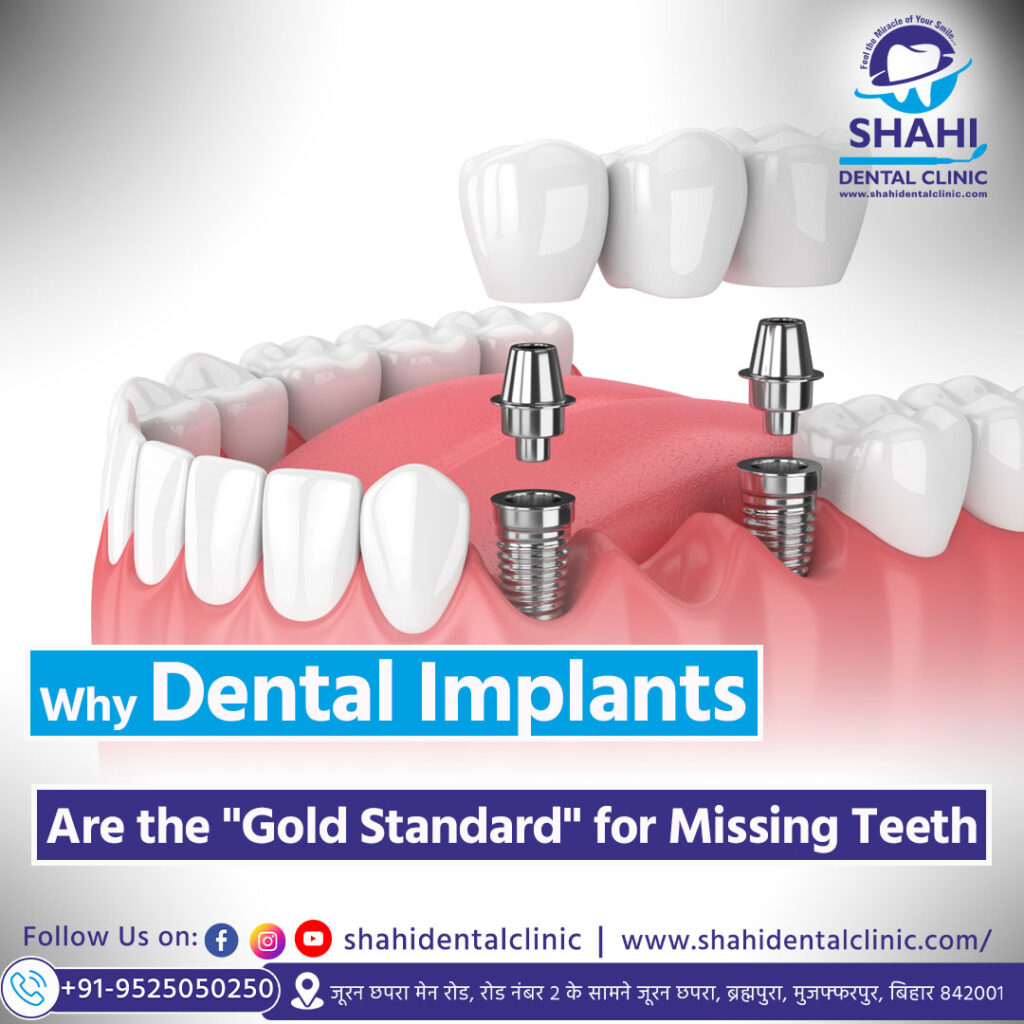
When you lose a tooth, the sudden gap in your smile can feel like a glaring flaw. Naturally, your first instinct is to find a way to fill that space as quickly as possible. If you start researching your options, or if you sit down for a consultation here at Shahi Dental Clinic, you will undoubtedly hear one specific treatment referred to time and time again as the “gold standard” of modern restorative dentistry: Dental Implants.
But what exactly does “gold standard” mean? In the medical and dental fields, this term isn’t thrown around lightly. It is reserved for a treatment that offers the highest level of efficacy, predictability, and long-term success compared to all other available alternatives.
While removable dentures and fixed dental bridges are valid, traditional methods for replacing missing teeth, dental implants have completely revolutionized the way we approach oral restoration. In this comprehensive guide, we will explore the science, the structural benefits, and the life-changing advantages that make dental implants the undisputed top choice for replacing missing teeth.
The Flaws of Traditional Replacements
To truly understand why implants are superior, we first need to look at how traditional tooth replacement methods work—and where they fall short.
For decades, the primary solutions for a missing tooth were removable partial dentures or fixed dental bridges.
- Removable Dentures rest on top of the gums. While they fill the visual gap, they do not provide the bite force of a natural tooth. Furthermore, they can slip, click, or move while you are eating or speaking, and the acrylic plates can cause friction and sore spots on your gum tissue.
- Fixed Bridges offer more stability than dentures because they are cemented into place. However, they come with a significant biological cost. To place a bridge, a dentist must permanently shave down the healthy enamel of the teeth on either side of the gap so they can act as “anchors” for the prosthetic tooth.
Both of these methods have one major fundamental flaw: they only replace the visible part of the tooth (the crown). They completely ignore what happens beneath the gum line.
The Implant Difference: Getting to the Root of the Problem
A natural tooth consists of two main parts: the crown (the white part you see) and the root (the part hidden beneath the gums that anchors into your jawbone).
Dental implants are the only restorative option that replaces both the visible tooth and the underlying root.
An implant system consists of three distinct components:
- The Implant Post: A small, highly engineered screw made of biocompatible titanium. This is surgically placed directly into the jawbone, exactly where your natural tooth root used to be.
- The Abutment: A connector piece that is securely attached to the top of the titanium post once it has healed.
- The Ceramic Crown: The final, visible prosthetic tooth. It is custom-crafted to match the exact color, shape, and translucency of your surrounding natural teeth, and it is firmly attached to the abutment.
Benefit 1: Unmatched Jawbone Preservation
This is arguably the most critical health benefit of choosing a dental implant. Your jawbone requires constant mechanical stimulation to maintain its density and volume. Every time you chew, the roots of your natural teeth send stress signals into the surrounding bone, telling your body to keep that bone strong and healthy.
When you lose a tooth, that stimulation disappears. The body, sensing that the bone is no longer needed to support a tooth, begins to resorb (melt away) the bone tissue. This leads to a sunken facial appearance, premature aging, and the destabilization of neighboring teeth.
Because a titanium implant is embedded directly into the bone, it acts exactly like a natural root. Through a fascinating biological process called osseointegration, your living bone tissue actually grows around and fuses with the titanium surface. This restores the essential mechanical stimulation to the jawbone, completely halting the bone loss process and preserving your natural facial structure. Neither dentures nor bridges can offer this vital health benefit.
Benefit 2: Protecting Your Remaining Healthy Teeth
In dentistry, our primary goal is the preservation of your natural biological structures. As mentioned earlier, placing a traditional dental bridge requires grinding down the perfectly healthy teeth adjacent to the gap. You are essentially sacrificing two healthy teeth to replace one missing one.
A dental implant is a completely standalone restoration. Because it supports itself entirely through the jawbone, there is absolutely no need to alter, drill, or damage your neighboring teeth. By choosing an implant, you are actively protecting the structural integrity of the rest of your smile.
Benefit 3: Superior Function and Unshakable Confidence
Living with missing teeth or loose dentures forces you to think about your mouth constantly. You might avoid eating your favorite foods—like crisp apples, tough meats, or crunchy nuts—for fear of pain or embarrassment.
Because dental implants are fused to your skeleton, they offer unparalleled strength and stability. They restore up to 99% of your natural bite force. You can bite, chew, and tear into any food with absolute confidence. Furthermore, because the ceramic crown is meticulously designed to blend in with your smile, no one—not even you—will be able to tell the difference between the implant and your natural teeth. You can laugh loudly, speak clearly, and smile broadly without a second thought.
Benefit 4: A Lifetime Investment
When evaluating the cost of dental treatments, it is crucial to look at the long-term return on investment. Removable dentures typically need to be relined or entirely replaced every 5 to 7 years as your jawbone changes shape. Dental bridges usually have a lifespan of 10 to 15 years before they need to be replaced, often due to decay developing under the anchor crowns.
Dental implants, on the other hand, boast a clinical success rate of over 95%. When placed by an experienced professional and cared for with proper daily brushing, flossing, and routine dental checkups, a dental implant is designed to last a lifetime. While the upfront cost may be higher than a bridge or a denture, an implant is almost always the most cost-effective solution over the span of a decade or more.
Demystifying the Procedure: It’s Easier Than You Think
Many patients shy away from implants because the word “surgery” sounds intimidating. However, at Shahi Dental Clinic, implant placement is a highly controlled, predictable, and routine procedure.
The placement of a single implant often takes less than 30 to 45 minutes. We use precise local anesthesia, meaning the area is completely numb. Most of our patients report that getting an implant is actually more comfortable and involves less post-operative soreness than having a tooth extracted. You can typically return to your normal daily activities the very next day.
Reclaim Your Complete Smile Today
You do not have to settle for the discomfort of missing teeth, the inconvenience of removable dentures, or the biological cost of a dental bridge. You deserve a solution that looks, feels, and functions like the real thing.
If you are ready to invest in the long-term health and beauty of your smile, it is time to explore the gold standard.
📍 Visit Us: Juran Chapra Main Road, Muzaffarpur 📞 Call/WhatsApp: +91-9525050250 🌐 Book Your Consultation: www.shahidentalclinic.com