
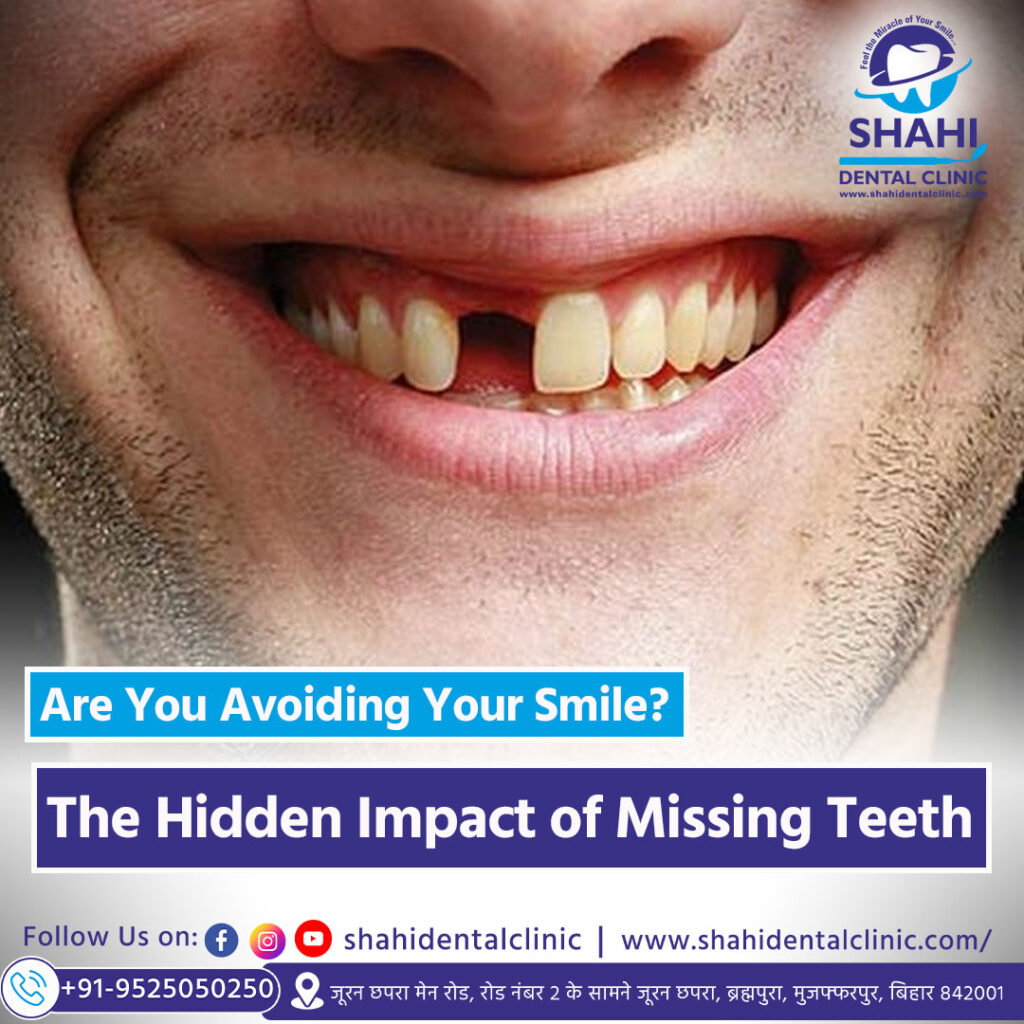
A smile is universally recognized as one of the most powerful tools of human connection. It is the first thing people notice about you when you walk into a room, the expression that conveys warmth and approachability, and a key factor in how you present yourself to the world. However, when you are missing a tooth—whether it was lost due to an accident, severe decay, or underlying gum disease—that effortless connection can suddenly become a source of profound anxiety.
At Shahi Dental Clinic, we frequently meet patients who have spent months, or even years, hiding their smiles. The immediate reaction to losing a tooth is often purely aesthetic; nobody wants a visible gap in their mouth. But as dental professionals, we know that the aesthetic concern is only the tip of the iceberg. The hidden impacts of a missing tooth extend far beyond what you see in the mirror. They weave into your psychological well-being, your daily physical comfort, your nutritional health, and the long-term structural integrity of your entire facial framework.
In this comprehensive guide, we are pulling back the curtain on exactly what happens when you ignore a missing tooth and why seeking a replacement solution is one of the most important investments you can make in your overall health.
The Silent Loss of Confidence and Psychological Impact
The emotional toll of losing a tooth is rarely discussed openly, but it is deeply felt. For many individuals, a missing tooth triggers a cascade of social anxieties. You might find yourself subtly altering your behavior to keep the gap hidden. Perhaps you start covering your mouth with your hand every time you laugh at a joke. Maybe you intentionally closed-lip smile in family photographs, or worse, you start avoiding the camera altogether.
This hyper-awareness can slowly chip away at your self-esteem. In professional settings, where confidence is key to making presentations or interacting with clients, the fear that someone might notice the missing tooth can be incredibly distracting. Instead of focusing on your work or the conversation at hand, a portion of your mental energy is constantly devoted to managing your facial expressions. Over time, this chronic self-consciousness can lead to social withdrawal, making you less likely to attend gatherings, dine out with friends, or engage in activities you once loved. The psychological burden is heavy, but it is completely avoidable with modern dental interventions.
The Domino Effect: Shifting Teeth and Bite Misalignment
While the psychological effects are significant, the physical consequences occurring beneath the surface are just as alarming. Your teeth are not static entities; they exist in a state of delicate balance, supporting one another like books tightly packed on a shelf. When you remove a book from the middle of the shelf, the surrounding books eventually lean and fall into the empty space. Your teeth behave in the exact same manner.
When a gap is left empty, the natural, healthy teeth adjacent to the space begin to slowly drift and tilt toward the void. This shifting does not happen overnight, but it is a relentless, continuous process. Furthermore, the tooth directly opposite the gap (on the opposing jaw) will often begin to super-erupt, growing outward because it no longer has a partner to bite against.
This domino effect disrupts the intricate alignment of your entire bite. What was once a perfectly interlocking system of upper and lower teeth becomes misaligned. This misalignment can lead to uneven wear and tear on your remaining teeth, increasing the risk of fractures and enamel erosion. It also forces your jaw muscles to work harder to chew, which frequently results in chronic headaches, neck pain, and severe issues with the temporomandibular joint (TMJ). What starts as one missing tooth can quickly escalate into a complex, full-mouth structural crisis.
The Invisible Danger: Jawbone Resorption and Facial Aging
Perhaps the most critical, yet least understood, consequence of missing teeth is jawbone loss, medically referred to as bone resorption. To maintain its density and volume, your jawbone requires constant physical stimulation. This stimulation is provided by the roots of your natural teeth every time you bite down or chew. The pressure is transferred through the root into the bone, signaling the body to continuously rebuild and nourish that area of the jaw.
When a tooth is extracted and not replaced with a root-mimicking structure (like a dental implant), that vital stimulation ceases immediately. Recognizing that the bone is no longer serving a purpose in that specific spot, the human body begins to resorb, or melt away, the bone tissue to use those minerals elsewhere. In the first year alone after losing a tooth, you can lose up to 25% of the supporting bone volume in that area, and the loss continues linearly year after year.
As the jawbone deteriorates, the entire structure of your face begins to change. The lower third of your face may begin to look sunken or collapsed. The lips can appear thinner, and deep wrinkles can prematurely form around the mouth. This phenomenon, often referred to as facial collapse, can make an individual look significantly older than their actual biological age. This is why preserving the bone through prompt tooth replacement is essential not just for oral health, but for maintaining your natural facial aesthetics.
Nutritional Deficits and Digestive Discomfort
Digestion does not begin in the stomach; it begins in the mouth. The physical breakdown of food by the teeth is the crucial first step in the digestive process. Each type of tooth serves a specific function: incisors cut, canines tear, and molars grind. When you are missing key teeth, especially the molars in the back of your mouth, your ability to efficiently grind your food is severely compromised.
Patients with missing teeth often subconsciously alter their diets to accommodate their compromised chewing ability. They tend to avoid tough, fibrous foods like raw vegetables, nuts, seeds, and certain lean proteins, gravitating instead toward softer, highly processed foods that require less effort to consume. This dietary shift can quickly lead to nutritional deficiencies, impacting your overall systemic health, immune function, and energy levels.
Furthermore, when food is not chewed properly before being swallowed, the stomach and intestines have to work significantly harder to break it down. This often leads to chronic digestive issues, including indigestion, acid reflux, bloating, and poor nutrient absorption. Restoring your complete bite is therefore not just a dental issue; it is fundamentally tied to your body’s ability to fuel itself properly.
Taking Action: The Shahi Dental Clinic Approach
The good news is that you do not have to accept these hidden consequencesbr. Modern dentistry offers highly effective solutions to restore the harmony, function, and aesthetics of your mouth. As Dr. Kautilya Swaroop highlights in his educational outreach, there are three primary paths to reclaiming your smile:
- Removable Partial Dentures: For those seeking a budget-friendly and non-invasive option, removable dentures provide artificial teeth attached to a pink, gum-colored plastic base. While they require daily removal for cleaning and can sometimes feel bulky to younger patients, they successfully fill the aesthetic gap and restore basic chewing function.
- Fixed Dental Bridges: If the teeth adjacent to the missing gap are healthy and robust, a fixed bridge is an excellent, permanent solution. By placing crowns on the neighboring teeth, we can “bridge” the empty space with a beautiful, custom-crafted artificial tooth that stays securely in your mouth 24/7.
- Dental Implants: This is the ultimate, gold-standard solution for preventing bone loss. By surgically placing a biocompatible titanium post directly into the jawbone, we replace the actual root of the missing tooth. Once healed, a lifelike ceramic crown is attached. Implants provide the crucial stimulation needed to halt bone resorption, protect your facial structure, and function identically to your natural teeth without relying on adjacent teeth for support.
Don’t Wait for the Dominoes to Fall
Ignoring a missing tooth is a gamble with your long-term health. The longer you wait, the more complex and expensive the eventual treatment can become due to shifting teeth and bone loss. At Shahi Dental Clinic, our priority is to equip you with the knowledge and the advanced clinical care necessary to make the best decision for your unique situation.
You deserve to eat your favorite foods without hesitation, to speak clearly without self-consciousness, and to smile brightly without hiding. Stop avoiding the camera and start living with confidence.
📍 Visit Us: Juran Chapra Main Road, Muzaffarpur 📞 Call/WhatsApp: +91-9525050250 🌐 Book Your Consultation: www.shahidentalclinic.com