
Introduction: The Invisible Destruction
When patients delay dental treatment out of fear, they usually operate under a dangerous assumption: “It’s just one tooth. Even if it rots completely, I’ll just get that one tooth pulled eventually.” This mindset treats the tooth as an isolated object, like a bad apple sitting in a basket. But human anatomy is deeply interconnected. A tooth is not an island; it is an organ deeply rooted into the structural foundation of your face.
As Dr. Kautilya Swaroop frequently witnesses at Shahi Dental Clinic, waiting out a toothache until the nerve dies does not end the disease—it simply moves the battlefield. When the infection leaves the tooth, it enters the jaw.
Relying on the detailed anatomical blueprints found in Orban’s Oral Histology and Embryology, this article explores the fascinating and destructive relationship between an infected tooth and its surrounding structures. Understanding the biology of the “periodontium” reveals why ignoring a cavity doesn’t just cost you a tooth; it can permanently dissolve your jawbone.
The Foundation: Meet the Periodontium
To understand bone loss, we must look beyond the white crown of the tooth.
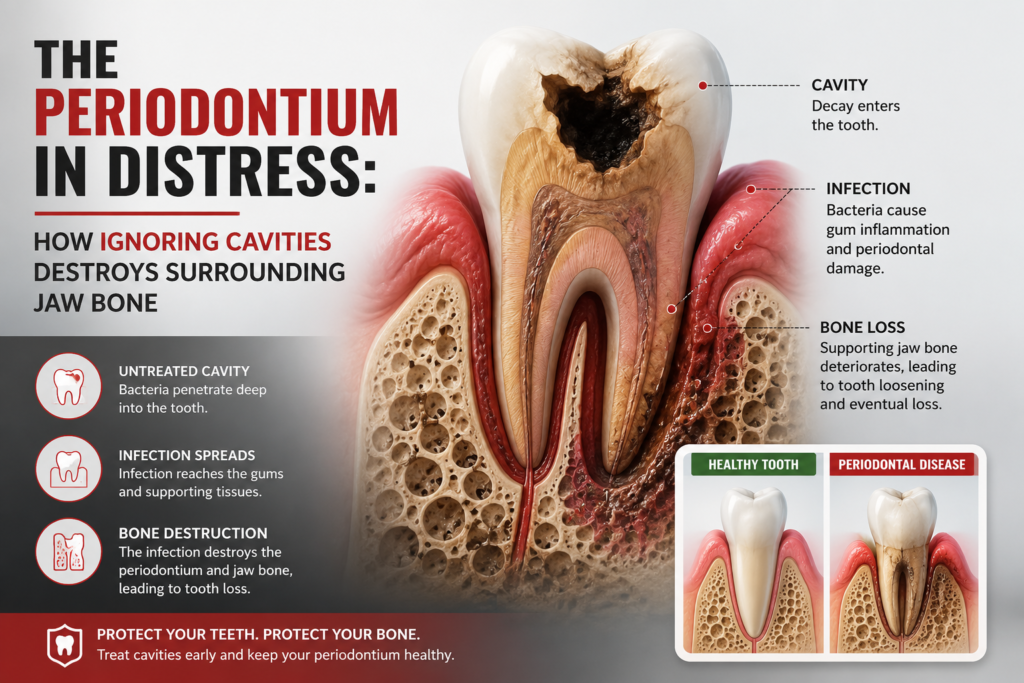
According to Orban’s Histology, a tooth is anchored into the jaw by a highly specialized group of tissues collectively known as the Periodontium. This system consists of four primary components:
- Gingiva: The pink gum tissue that acts as a protective collar.
- Cementum: A calcified layer covering the roots of the tooth.
- Periodontal Ligament (PDL): The microscopic hammock of collagen fibers suspending the tooth.
- Alveolar Bone: The specialized ridge of jawbone that forms the sockets holding the teeth.
The alveolar bone is incredibly dynamic. It exists solely to support the teeth. When a tooth is healthy, the forces of chewing stimulate the alveolar bone, keeping it dense and strong. But when a tooth becomes a source of severe, chronic infection, this protective bone becomes the primary victim.
The Spillover: When Bacteria Breach the Fortress
As discussed in our previous blogs, when a deep cavity is ignored, the dental pulp (nerve) inside the tooth becomes infected and eventually dies. Because blood can no longer enter the dead tooth, the immune system cannot reach the bacteria hiding inside the rigid dentin walls.
Eventually, this toxic soup of multiplying bacteria, dead tissue, and inflammatory gases seeks an exit. It pushes out through the apical foramen—the microscopic opening at the very tip of the tooth root—and spills directly into the Periodontal Ligament and the surrounding Alveolar Bone.
You have now transitioned from a simple toothache to a deep skeletal infection.
The Double-Edged Sword: How Your Immune System Melts Bone
When millions of bacteria flood into the sterile jawbone, the body’s immune system detects a massive crisis. It sounds the biological alarm to prevent the infection from spreading into the bloodstream or up into the brain.
The immune system rushes white blood cells (macrophages and neutrophils) to the root tip to build a physical wall around the infection, trapping it. Histologically, this wall of immune cells and inflamed tissue is known as a periapical granuloma.
But this defense mechanism has a devastating side effect.
To make room for this granuloma, the immune system must clear out the surrounding solid bone. It deploys specialized cells called osteoclasts (bone-destroying cells). These osteoclasts secrete acids and enzymes that literally dissolve the calcium matrix of your alveolar bone.
This process is called bone resorption. Your body is actively sacrificing its own jawbone to quarantine the dental infection.
The Cysts and the Domino Effect
If the patient continues to rely on painkillers and delays visiting the clinic, the granuloma can evolve into a radicular cyst— a fluid-filled sac that acts like a slowly inflating balloon inside the jaw.
As the cyst grows, the osteoclasts continue to dissolve more and more bone to make room for it. This silent destruction causes two massive problems:
- The Loss of the Tooth: The alveolar bone is the foundation that holds the tooth in place. As the bone dissolves away, the infected tooth becomes increasingly loose and mobile.
- The Domino Effect: The jawbone does not respect property lines. As the cyst expands, it destroys the bone supporting the neighboring, perfectly healthy teeth. What started as one ignored cavity can result in the loss of two or three adjacent teeth because their shared bony foundation has melted away.
The Aesthetic and Functional Collapse
The consequences of alveolar bone loss are permanent. Unlike a cut on your arm, dissolved jawbone does not simply grow back on its own once the tooth is removed.
When severe bone loss occurs, the facial structure begins to collapse inward, causing premature aging and sagging of the cheeks. Furthermore, if a patient eventually wants to replace the missing tooth with a modern Dental Implant, they face a new hurdle: implants require thick, healthy bone for anchoring. If the bone has been destroyed by a chronic infection, the patient will require expensive and time-consuming bone grafting surgeries before an implant can even be considered.
“Problem ko paal-pos ke bada karna” (nurturing the problem) is not just a metaphor; you are literally nurturing a cyst that is eating your jaw.
The Painless Intervention: Stop the Destruction Instantly
The most frustrating aspect of alveolar bone loss is that it is 100% preventable.
When you visit Shahi Dental Clinic, the priority is to stop the infection at the source before it compromises your jaw. Because the nerve inside the offending tooth is dead, the intense pain you feel is from the pressure in the bone.
By utilizing advanced LA sprays and precise local anesthesia, Dr. Swaroop can completely numb the surrounding periodontium. You will feel no pain, only light pressure. The doctor will then perform a Root Canal Treatment (RCT) to painlessly clean and disinfect the inside of the tooth.
Once the bacterial fortress inside the tooth is sterilized and sealed, the immune system calls off the attack. The osteoclasts stop destroying the bone. Over the next few months, osteoblasts (bone-building cells) will naturally fill in the cyst cavity, regenerating the lost bone and tightening the tooth back into place.
If the tooth is too far gone, a painless, atraumatic extraction will remove the source of infection, and the socket will be preserved for future restorative work.
Conclusion: Protect Your Foundation
Do not let the fear of a temporary dental appointment trick you into sacrificing the permanent skeletal structure of your face.
A toothache is not an isolated event; it is a biological warning that your periodontium is under attack. Popping antibiotics or painkillers only masks the pain while the osteoclasts continue their silent destruction beneath your gums.
Modern dentistry is designed to be comfortable, efficient, and biologically restorative. Stop the bone loss today.
Don’t wait until your foundation collapses. Book your stress-free, painless consultation at Shahi Dental Clinic to save your smile and your jaw.
📍 Shahi Dental Clinic Juran Chapra Main Road, Opposite Road No. 2, Muzaffarpur, Bihar
📞 Call/WhatsApp: +91-9525050250
🌐 Website: www.shahidentalclinic.com