
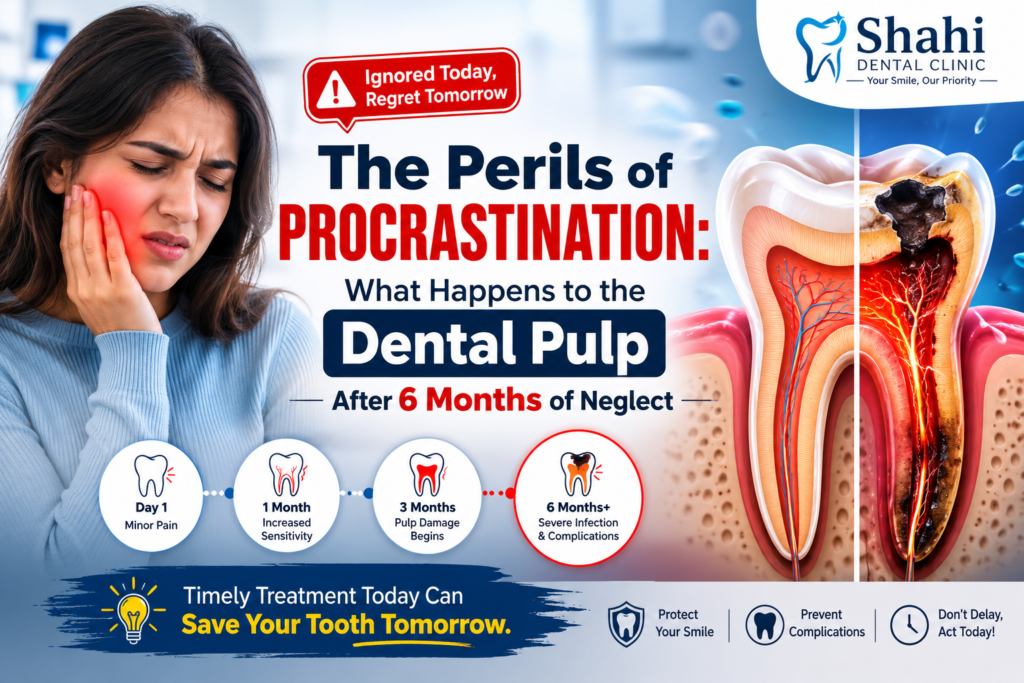
Introduction: The Psychology of “Waiting It Out“
In his recent video on dental anxiety, Dr. Kautilya Swaroop highlighted a dangerous, yet incredibly common, patient behavior: “Log chhe-saat mahina problem lekar, problem ko paal-pos ke bada karke baithe rehte hain…“ (People sit with the problem for six to seven months, nurturing it and letting it grow).
When a patient feels the first twinge of dental pain, their immediate instinct is rarely to book a dental appointment. Instead, fear takes the wheel. The patient enters a cycle of bargaining: they switch to chewing on the opposite side of their mouth, they start taking over-the-counter painkillers, and they avoid cold drinks. They convince themselves that if they just ignore it long enough, the pain will magically fade.
But human biology does not reward procrastination. Unlike a muscle strain or a mild viral infection, a decaying tooth has zero capacity to heal itself.
To fully grasp the severe consequences of the “waiting game,” we must look at the microscopic timeline of an untreated cavity. Drawing on the foundational science of Orban’s Oral Histology and Embryology, this article provides a month-by-month breakdown of exactly what happens inside your tooth when you delay treatment for six months—and why modern, painless dentistry is the only logical solution.
Month 1: The Silent Breach (Enamel Breakdown)
The first month of neglect is often completely silent. Dental decay begins when bacteria (primarily Streptococcus mutans) feed on sugars in your mouth and excrete lactic acid.
According to histological principles, your tooth’s outer layer—the enamel—is highly mineralized, avascular, and lacks nerve endings. As the acid slowly dissolves this calcium fortress, a microscopic hole (cavity) forms. Because there are no nerves in the enamel, you feel absolutely no pain.
At this stage, the treatment would simply involve a quick, painless 10-minute filling. But because the patient feels no pain, they remain unaware or dismissive of the slight discoloration on their tooth.
Month 2: The Warning Bells (Dentin Penetration)
By the second month, the bacteria have breached the enamel and entered the second layer of the tooth: the dentin.
As detailed in Orban’s Histology, dentin is not solid; it is porous, consisting of millions of microscopic dentinal tubules containing fluid and cellular extensions from the nerve. When the bacteria invade this porous layer, external stimuli (like hot tea, ice water, or sweet foods) cause the fluid inside these tubules to shift rapidly.
This is the month of hypersensitivity. The patient experiences a sharp, electric “zing” of pain when eating or drinking. This is the tooth’s early warning system. Instead of visiting Shahi Dental Clinic, the anxious patient begins the coping phase: avoiding cold water and popping mild painkillers. The bacteria continue their march inward.
Month 3 & 4: The War Inside the Pulp (Reversible to Irreversible Pulpitis)
By the third and fourth months, the bacterial invasion reaches the inner sanctum of the tooth: the dental pulp. The pulp is the living heart of the tooth, densely packed with blood vessels, connective tissue, and complex nerve networks.
When bacteria enter the pulp chamber, the body launches an immune response. Orban’s Oral Histology describes this phase as pulpal hyperemia. Blood vessels dilate to bring in white blood cells (leukocytes) to fight the infection.
However, a fatal biological design flaw occurs here: the pulp is encased in rigid, unyielding walls of dentin. When tissue elsewhere in your body swells, it expands. But the dental pulp cannot expand. As the blood vessels dilate, the internal pressure of the tooth skyrockets.
This condition is known as Irreversible Pulpitis. The patient is now in sheer agony. The pain changes from a fleeting “zing” to a constant, heavy, throbbing nightmare that radiates into the jaw and head. It becomes impossible to sleep. The patient is surviving on heavy painkillers, yet fear still keeps them away from the dental chair.
Month 5: The Strangulation (Pulpal Necrosis)
By the fifth month, the internal pressure within the rigid dentin walls reaches a critical mass. The pressure becomes so immense that it physically crushes the tooth’s own blood vessels against the hard walls.
Blood flow stops. Oxygen is cut off. The tissue inside the tooth undergoes liquefaction necrosis. In simple terms: the nerve dies.
Paradoxically, this is the month where the patient might feel a sudden, misleading sense of relief. Because the nerve has died, the intense throbbing pain may stop. The patient falsely believes the painkillers have finally “cured” the problem. In reality, the tooth has simply become a hollow tomb filled with dead tissue, toxic gases, and multiplying bacteria.
Month 6: The Spillover (Periapical Infection and Abscess)
By the sixth month, the dead pulp chamber cannot contain the bacterial load. The infection has nowhere to go but down. It exits through the apical foramen (the microscopic opening at the very tip of the tooth root) and violently invades the surrounding alveolar jawbone.
This is the disaster stage Dr. Swaroop warns about. The body attempts to wall off the infection, creating a pool of pus known as an apical abscess.
The consequences of this 6-month delay are severe:
- Massive Swelling: The patient’s face, cheek, or jaw may swell dramatically as the pus expands into the surrounding soft tissues.
- Bone Destruction: The inflammatory enzymes actively dissolve the jawbone surrounding the tooth root.
- Systemic Threat: If left untreated, the infection can enter the bloodstream or spread to the fascial spaces of the neck, causing a severe, life-threatening medical emergency.
- Excruciating Pressure: The pain returns, often worse than before, because the pressure is now building inside the jawbone itself.
This is the moment the patient finally walks into the clinic, exhausted, unable to eat, and begging for a magical pill.
The Clinical Reality: Erasing the Fear
The tragedy of this 6-month timeline is that it is entirely preventable. The patient endured half a year of worsening pain, lost sleep, and bone destruction simply because they were afraid of the dental chair.
Patients assume that because the infection is severe, the treatment will be agonizing. This is fundamentally false.
Even at Month 6, modern dentistry provides immediate, painless relief. Because the nerve inside the tooth is already dead, the pain is coming from the pressure in the bone. By utilizing advanced Local Anesthesia (LA) sprays and precision injection techniques, Dr. Swaroop can completely numb the surrounding jaw.
Once profound anesthesia is achieved, the doctor will either perform a Root Canal Treatment (RCT) to clean out the necrotic tissue and disinfect the hollow chamber, or execute a painless surgical extraction to remove the toxic tooth entirely. The moment the chamber is opened or the tooth is removed, the trapped gases and pus are released, providing instant, overwhelming relief from the pressure.
Conclusion: Time is Your Worst Enemy
When it comes to dental decay, time is not a healer; it is an amplifier. What begins as a microscopic, easily fixable lesion in Month 1 evolves into a bone-destroying, necrotic infection by Month 6.
“Problem ko paal-pos ke bada karna” (nurturing the problem to make it big) is a high price to pay for a fear that belongs in the past. Today’s dentistry relies on advanced chemistry, profound local anesthesia, and microscopic precision to ensure that your treatment is completely comfortable.
If you are currently in Month 1, Month 3, or even Month 6 of this timeline, the solution is the same: stop waiting. Stop relying on temporary painkillers that cannot cure a dead tooth.
Take control of your oral health before the infection spreads. Book your stress-free, totally painless consultation at Shahi Dental Clinic today.
📍 Shahi Dental Clinic Juran Chapra Main Road, Opposite Road No. 2, Muzaffarpur, Bihar
📞 Call/WhatsApp: +91-9525050250
🌐 Website: www.shahidentalclinic.com