
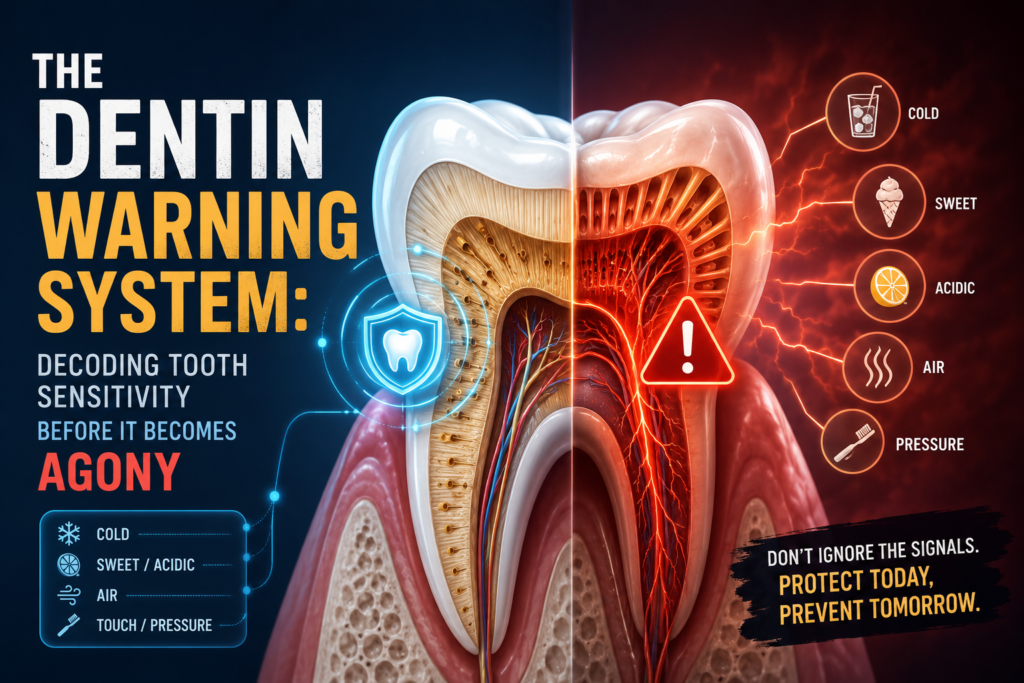
Introduction: The “Zing” You Shouldn’t Ignore
It usually happens over dinner or during a hot summer afternoon. You take a sip of ice-cold water, bite into a sweet dessert, or draw in a breath of cold winter air, and suddenly—zing! A sharp, electric shock of pain shoots through your tooth. It lasts only a second, disappearing as quickly as it arrived.
Because the pain is fleeting, the human brain quickly rationalizes it. You tell yourself it is nothing serious. You start chewing on the other side of your mouth and avoid iced drinks. As Dr. Kautilya Swaroop observes daily at Shahi Dental Clinic, this is the exact moment when the psychological trap of dental anxiety begins. Patients choose to adapt their eating habits rather than step into a dental clinic, terrified that “the machine” or “the needle” will hurt more than the sensitivity itself.
But what is actually happening inside your mouth during that brief second of pain?
That sharp shock is not a random glitch; it is a highly evolved biological alarm system. Drawing upon the microscopic principles detailed in Orban’s Oral Histology and Embryology, this article decodes the science of dentin hypersensitivity. Understanding your tooth’s built-in warning system will show you exactly why visiting the dentist at this stage is the easiest, most painless decision you can make.
The Armor and The Core: A Tale of Two Tissues
To understand sensitivity, we must look at the structural difference between the outside of your tooth and the inside.
The visible crown of your tooth is covered by enamel. According to histological science, enamel is a marvel of nature. It is 96% mineral, making it the hardest substance in the human body. More importantly, enamel is completely dead. It contains no cells, no blood vessels, and absolutely no nerve endings. As long as your enamel is intact, you can chew ice, drink boiling tea, and eat sugary sweets without feeling a thing.
However, enamel is just a protective shell. Beneath it lies the bulk of the tooth: the dentin.
Unlike enamel, dentin is a living, breathing tissue. It surrounds the dental pulp (the nerve center of the tooth) and acts as the vital link between the protective armor and the sensitive core. When enamel is worn away—whether through bacterial decay (cavities), aggressive brushing, or acidic diets—the underlying dentin is exposed to the harsh environment of your mouth.
The Microscopic Architecture: The Dentinal Tubules
When you look at exposed dentin with the naked eye, it looks like solid, yellowish bone. But if you were to place it under a high-powered microscope, as depicted in Orban’s Oral Histology, you would see something entirely different.
Dentin is actually porous. It is made up of millions of microscopic, hollow channels called dentinal tubules.
These tubules run radially from the outside of the dentin all the way deep inside to the dental pulp. Inside each of these microscopic tubes is a fluid (dentinal fluid) and a tiny, hair-like cellular extension called an odontoblastic process, which connects directly to the nerve endings in the pulp.
Imagine millions of microscopic straws leading directly from the surface of your tooth straight into the central nerve. When your enamel is breached, these straws are left wide open.
The Hydrodynamic Theory: Why Cold Causes Pain
For decades, scientists debated exactly how exposed dentin caused pain. Was the cold temperature traveling through the tooth? Were chemicals touching the nerve?
The accepted scientific explanation is known as the Hydrodynamic Theory (originally proposed by Dr. Martin Brännström). It all comes down to fluid dynamics.
When you drink a glass of ice water, the sudden drop in temperature causes the fluid inside those millions of microscopic dentinal tubules to contract. When you eat something sugary, osmotic pressure causes the fluid to be rapidly drawn outward.
This sudden, violent shifting of fluid inside the microscopic tubes acts like a plunger. It yanks on the odontoblastic processes and triggers the nerve endings in the pulp. The nerve fires a rapid, sharp warning signal to the brain: Warning! The protective armor has been breached!
This is the sharp “zing” of tooth sensitivity. The nerve is not yet infected; it is simply being mechanically aggravated by the movement of fluid.
The Golden Window: Reversible vs. Irreversible Pulpitis
When your tooth acts as a warning system, you have entered a critical window of opportunity. In clinical terms, this stage is known as Reversible Pulpitis.
The nerve inside the tooth is irritated by the fluid movement, but it is still perfectly healthy and capable of healing. If you intervene now, the tooth can be saved easily.
However, if you let fear dictate your actions and ignore the warning, the open dentinal tubules act as a superhighway for bacteria. The bacteria in your mouth will swim down those microscopic tubes and invade the dental pulp. Once the bacteria breach the pulp chamber, the tissue becomes infected, swells, and dies. This is Irreversible Pulpitis—the stage of agonizing, throbbing pain that keeps you awake at night and requires a Root Canal or an extraction.
Ignoring sensitivity is the equivalent of hearing your car’s engine knocking and turning up the radio to ignore the sound. Eventually, the engine will blow.
The Painless Fix: Why Early Intervention is Fear-Free
The tragic irony of dental anxiety is that patients avoid the dentist when the treatment is easiest.
If you visit Shahi Dental Clinic while your tooth is only experiencing the sharp, fleeting pain of sensitivity, the treatment is incredibly conservative and completely painless. Because the nerve is not infected, Dr. Swaroop does not need to perform invasive surgery.
The goal is simply to seal the microscopic tubes. This can be achieved in several pain-free ways:
- Desensitizing Agents: For minor enamel wear, the dentist can apply a special fluoride varnish or bonding resin that acts like microscopic superglue, instantly plugging the open dentinal tubules and stopping the fluid movement. No drilling required.
- Simple Fillings: If a small cavity has breached the dentin, the decayed portion is gently cleaned. Because it is a surface-level issue, the advanced LA spray and localized anesthesia make the process 100% numb. A tooth-colored composite resin is then placed to seal the tooth, replacing the lost enamel armor.
The entire process takes less than 20 minutes, requires minimal intervention, and instantly cures the sensitivity.
Conclusion: Do Not Wait for the Agony
Your body is highly intelligent. The sharp pain of dentin hypersensitivity is a gift—it is a microscopic alarm bell ringing before the real damage is done.
Do not let outdated fears and the myth of the “painful dental chair” convince you to silence the alarm with painkillers or by chewing on the other side of your mouth. Modern dentistry understands the precise histological mechanisms of your pain, and we have the exact tools to stop it comfortably.
Listen to your body’s warning system. If you are experiencing sensitivity to hot, cold, or sweet foods, you are in the golden window for simple, painless care.
Seal the breach before the bacteria take over. Book a stress-free, painless consultation at Shahi Dental Clinic today.
📍 Shahi Dental Clinic Juran Chapra Main Road, Opposite Road No. 2, Muzaffarpur, Bihar
📞 Call/WhatsApp: +91-9525050250
🌐 Website: www.shahidentalclinic.com