
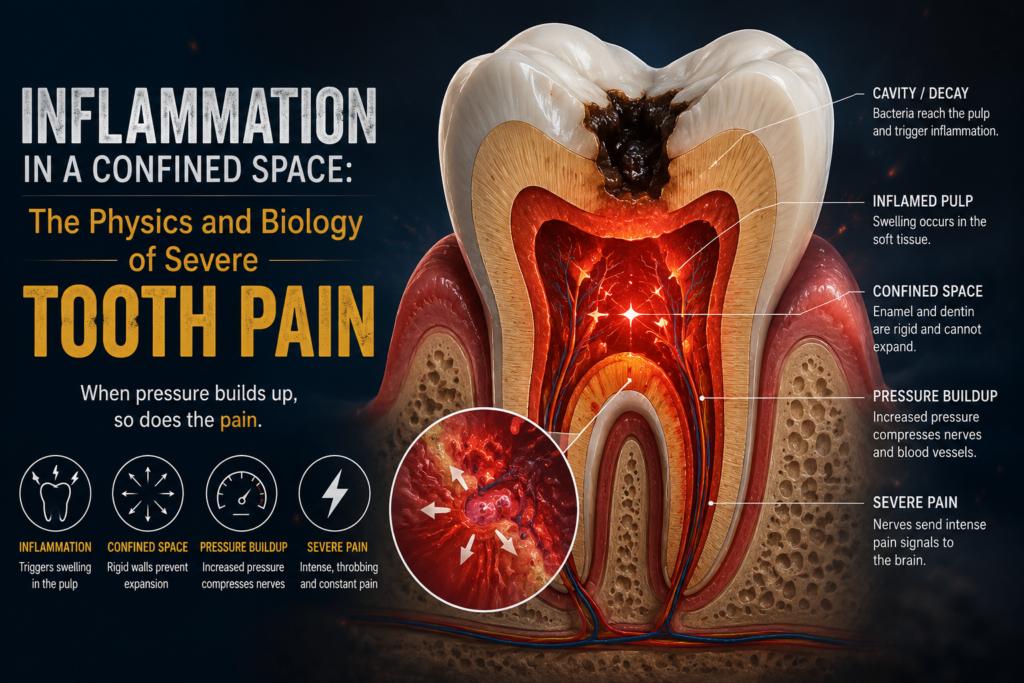
Introduction: The Unique Agony of a Toothache
There is a universal truth acknowledged by anyone who has ever suffered a severe dental infection: a toothache does not feel like any other pain in the human body.
If you twist your ankle, it aches. If you cut your finger, it stings. But when a tooth becomes deeply infected, the pain is entirely different. It is a violent, rhythmic, throbbing agony that pulses in time with your heartbeat. It consumes your attention, makes sleeping impossible, and can radiate so intensely that your entire jaw, ear, and head feel like they are splitting open.
This unique level of suffering is exactly why patients in Dr. Kautilya Swaroop’s recent video eventually surrender. After weeks or months of saying, “Dard manzoor hai, lekin doctor ke paas nahi jayenge“ (I will tolerate the pain, but I won’t go to the doctor), the sheer intensity of the pain finally breaks their resolve.
But why does a tiny tooth have the power to cause such overwhelming, paralyzing pain?
The answer lies not just in biology, but in the unforgiving laws of physics. Drawing upon the foundational science of Orban’s Oral Histology and Embryology, this article explores the fascinating phenomenon of “closed-space inflammation.” Understanding the mechanics of your pain is the key to understanding how Dr. Swaroop and the team at Shahi Dental Clinic can eliminate it instantly and painlessly.
The Standard Biological Response: How Inflammation Usually Works
To understand why a toothache goes wrong, we must first look at how the body normally handles an injury or infection.
When you get a splinter in your finger, bacteria enter the tissue. Your immune system immediately detects the invaders and launches an inflammatory response. The blood vessels in the area dilate (widen) to increase blood flow, rushing white blood cells, antibodies, and fluid to the site to fight the infection.
The classic signs of inflammation are redness, heat, pain, and—most importantly—swelling.
Because your skin and muscle tissue are flexible, they stretch. The area around the splinter swells outward, accommodating the extra fluid and blood. While it might be tender to the touch, the expansion prevents the internal pressure from reaching catastrophic levels. The tissue simply makes room for the biological battle taking place.
The Rigid Fortress: The Anatomy of the Dental Pulp
Now, let us look at the microscopic architecture of a tooth.
As detailed in Orban’s Oral Histology, the center of your tooth houses the dental pulp. This is a highly vascular, deeply innervated soft tissue—very much like the soft tissue in your finger. It contains delicate blood vessels, connective tissue, and a dense network of sensory nerves (part of the Trigeminal nerve system).
However, unlike your finger, the dental pulp is not surrounded by flexible skin. It is entirely encased in a rigid, unyielding vault of dentin and enamel. The walls of the pulp chamber cannot stretch, cannot bend, and cannot expand—not even by a fraction of a millimeter.
This anatomical design works perfectly when the tooth is healthy, protecting the delicate nerves from the massive crushing forces of chewing. But when the tooth becomes infected, this fortress becomes a torture chamber.
The Physics of the Throb: Biology Meets an Immovable Object
When an untreated cavity finally allows bacteria to breach the pulp chamber, the immune system reacts exactly as it did with the splinter: it triggers inflammation. The blood vessels inside the tooth dilate, trying to rush white blood cells and fluid to fight the bacterial invasion.
This is where biology violently clashes with physics.
The soft tissue tries to swell, but the hard dentin walls refuse to give way. Because the fluid has absolutely nowhere to expand, the internal pressure within the microscopic chamber skyrockets. In medical terms, this is a massive spike in intrapulpal pressure.
This extreme pressure is responsible for the unique, agonizing symptoms of a severe toothache:
- The Throbbing: The pain pulses in time with your heartbeat. Why? Because every time your heart beats, it attempts to pump more blood into the already over-pressurized tooth. The microscopic surge of blood hits the rigid walls, sending a shockwave of pressure directly into the trapped nerve.
- The Postural Agony: Have you ever noticed that a toothache gets infinitely worse the moment you lie down in bed? When you are horizontal, gravity causes more blood to flow to your head, further increasing the vascular pressure inside the confined pulp chamber.
The Strangulation Effect: Why the Nerve Dies
If the pressure is not relieved mechanically, it reaches a terrifying biological threshold.
Orban’s Histology explains that the blood vessels entering the tooth must pass through a microscopic hole at the tip of the root (the apical foramen). As the intrapulpal pressure continues to build, it eventually exceeds the pressure of the blood trying to enter the tooth.
The swelling tissue literally crushes its own blood supply against the hard walls of the tooth. The veins compress first, trapping the blood inside. Then, the arteries compress. Circulation stops entirely.
Deprived of oxygen and crushed by the pressure, the nerve and the soft tissue undergo necrosis. The pulp dies. While the sharp throbbing might temporarily cease once the nerve is dead, the dead tissue and bacteria will soon spill out of the root, creating a massive, bone-destroying abscess in the jaw.
Why Painkillers Only Scratch the Surface
Understanding this physics-based phenomenon perfectly explains why patients who try to self-medicate are left frustrated and in pain.
When you take an over-the-counter anti-inflammatory pill, it acts systemically to reduce swelling. But a pill cannot alter the laws of physics. It cannot decompress a sealed, rigid box of bone. The medication might take the absolute edge off the pain, but the crushing intrapulpal pressure remains.
To cure the pain, you must release the pressure. It requires a mechanical solution to a physical problem.
Decompression: The Miracle of Modern, Painless Relief
The extreme pain of closed-space inflammation is exactly why patients are terrified to have the tooth touched. They assume the treatment will hurt as much as the disease.
At Shahi Dental Clinic, Dr. Swaroop utilizes modern anesthetics to bypass this issue entirely. Using an advanced Local Anesthesia (LA) spray followed by precise numbing techniques, the nerves surrounding the tooth are completely silenced. The patient feels nothing.
Once the area is profoundly numb, the dentist performs the ultimate mechanical relief: Decompression.
During the first step of a Root Canal Treatment, the dentist creates a tiny, precise opening through the top of the enamel and dentin into the pulp chamber. The moment that rigid vault is opened, the trapped fluid, inflammatory gases, and pressure instantly vent outward.
Patients frequently report an almost immediate, overwhelming sense of physical and psychological relief. The throbbing stops. The pressure vanishes. The agonizing physics of the confined space are instantly neutralized. The dentist then calmly and painlessly cleans out the infected tissue, saving the tooth and eliminating the disease.
Conclusion: Do Not Fight the Laws of Physics
You cannot out-medicate the physics of closed-space inflammation. Allowing a bacterial infection to pressurize the inside of your tooth until it strangles its own blood supply is an excruciating and entirely unnecessary ordeal.
If you are experiencing a throbbing toothache, especially one that wakes you up at night or worsens when you lie down, your pulp chamber is actively under pressure. Do not wait for the nerve to die or for an abscess to form.
Modern dentistry understands exactly how to relieve this pressure instantly, safely, and without adding to your pain.
Stop suffering through the physics of a toothache. Book a completely painless, immediate relief consultation at Shahi Dental Clinic today.
📍 Shahi Dental Clinic Juran Chapra Main Road, Opposite Road No. 2, Muzaffarpur, Bihar
📞 Call/WhatsApp: +91-9525050250
🌐 Website: www.shahidentalclinic.com