
Introduction: The Ultimate Goal is Preservation
Throughout this 10-part series, we have explored the deep-seated fears that keep patients away from the dental chair. As Dr. Kautilya Swaroop highlighted in his candid video, the most common plea he hears at Shahi Dental Clinic is: “Doctor sahab, daant nahi nikaliyega!” (Doctor, please don’t extract the tooth!).
Patients are terrified of losing pieces of themselves. They fear that stepping into a clinic means aggressive drilling, pulling, and a permanent loss of their natural smile.
But this fear is rooted in an outdated era of medicine. The ultimate goal of modern dentistry is not extraction; it is preservation.
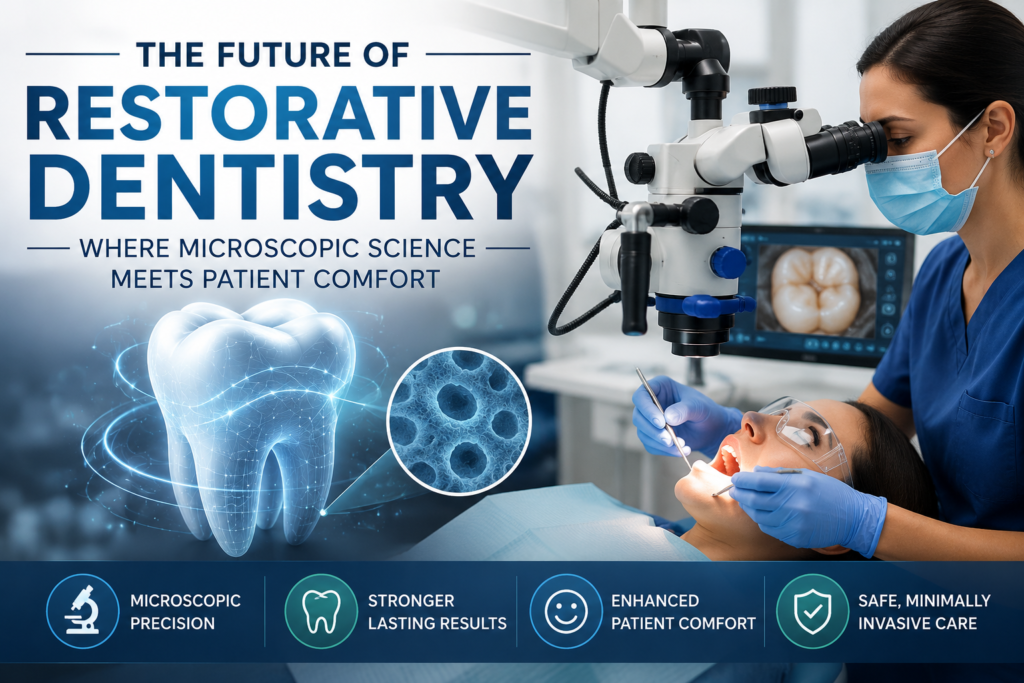
Today, we stand at the pinnacle of dental science. Drawing on the intricate biological blueprints mapped out in Orban’s Oral Histology and Embryology, modern restorative dentistry has evolved into a discipline known as biomimetics—the science of mimicking nature. In this final installment, we will explore how microscopic science has transformed tooth restoration into a conservative, highly esthetic, and completely painless art form.
The End of the “Drill and Fill” Era
To appreciate the future, we must quickly look at the past. Decades ago, the standard material for filling a cavity was silver amalgam (a metal alloy).
Metal does not chemically bond to human bone or teeth. Therefore, to make a silver filling stay in place, dentists had to use the “drill and fill” method. They had to aggressively drill away a significant amount of healthy tooth structure just to create a mechanical wedge—a box shape—so the metal wouldn’t fall out. This extensive drilling is exactly what created the terrifying noise, vibration, and pain that older generations associate with the dentist.
Furthermore, metal is rigid. As Orban’s Histology points out, natural teeth are slightly flexible. Over the years, the rigid metal filling would act like a wedge, slowly causing microscopic fractures in the remaining natural enamel every time the patient chewed.
Biomimetics: Replicating Human Histology
Modern dentistry at Shahi Dental Clinic has abandoned the destructive wedge. Instead, treatments are guided by biomimetics. If we must replace a part of a tooth, we use materials that physically and microscopically mimic the natural tissues they are replacing.
- Replacing Enamel: Natural enamel is the hardest, most mineralized tissue in the body, but it is brittle. Modern composite resins are engineered with microscopic glass and ceramic filler particles to match the exact hardness and light-reflecting properties of natural enamel.
- Replacing Dentin: Beneath the enamel lies the dentin, a porous, living tissue that acts as a shock absorber. Advanced restorative materials are designed with the exact same flexural strength (the ability to bend slightly without breaking) as human dentin.
When a modern restoration is placed, it does not fight against the natural tooth; it moves, flexes, and distributes chewing forces exactly like a natural, healthy tooth.
The Magic of Micromechanical Bonding
The true revolution in patient comfort is how these new materials are attached to the tooth. Because we no longer rely on wedges, the aggressive “drill and fill” method is obsolete.
Instead, Dr. Swaroop utilizes a process called micromechanical bonding.
Once the decayed, infected portion of the tooth is gently removed, the healthy tooth structure is preserved. A mild, specialized conditioning gel is applied to the surface. On a microscopic level, this gel dissolves a tiny fraction of the minerals, opening up thousands of microscopic pores in the enamel and exposing the dentinal tubules.
A liquid bonding resin is then brushed onto the tooth. This resin flows deep into those microscopic pores. When a specialized blue curing light is applied, the resin instantly hardens, locking itself into the microscopic architecture of the tooth.
Why this matters for your comfort: Because the filling chemically bonds to the tooth, the dentist only needs to remove the decay. There is zero unnecessary drilling. Less drilling means less vibration, less noise, and absolutely zero trauma to the healthy parts of your tooth.
The Biological Seal: Preventing Future Pain
As we learned in Blog 5, open dentinal tubules are the primary cause of severe tooth sensitivity. The fluid inside these microscopic tubes shifts, sending sharp pain signals to the nerve.
The micromechanical bonding process completely eliminates this issue. When the resin flows into the dentinal tubules and hardens, it acts as a permanent, microscopic cork. The tubules are hermetically sealed. Fluid can no longer move. Bacteria can no longer enter.
This means that after a modern composite restoration at Shahi Dental Clinic, patients experience virtually zero postoperative sensitivity. You can drink a glass of ice water immediately after your appointment without feeling that dreaded sharp “zing.” The nerve inside the tooth is safely locked away behind a biomimetic fortress.
The Masterpiece of Patient Comfort
The science of micromechanical bonding and biomimetics operates on a scale invisible to the naked eye, but the results for the patient are life-changing.
When you combine this conservative, minimal-drilling approach with the advanced Local Anesthesia (LA) sprays and profound numbing techniques discussed in Blog 2, the dental experience is completely transformed.
A restorative appointment today looks like this:
- Your gums are sprayed so you don’t feel the injection.
- Your tooth is profoundly numbed.
- The decay is gently removed without aggressive drilling.
- The biomimetic resin is sculpted to match the exact anatomical grooves of your natural tooth.
- It is hardened instantly with a light.
You walk out with a tooth that looks entirely natural, functions perfectly, and feels completely normal—all while experiencing zero pain.
Conclusion: Claim Your Pain-Free Smile
For the past ten blogs, we have explored the anatomy of your pain, the biology of your fear, and the catastrophic costs of procrastination. The central theme remains the same: the fear of the dentist is a ghost from the past.
Do not let the “door and string” stories of yesterday prevent you from experiencing the technological miracles of today. Allowing a minor cavity to rot into a bone-destroying infection simply because you are afraid of the drill is a tragedy of misinformation.
At Shahi Dental Clinic, Dr. Kautilya Swaroop and his team are not just fixing teeth; they are restoring confidence, eliminating pain, and preserving your natural smile using the most advanced science available.
The pain you are living with right now is a choice. Relief is just one appointment away.
Leave your fear at the door. Step into the future of restorative dentistry and book your stress-free, 100% painless consultation at Shahi Dental Clinic today.
📍 Shahi Dental Clinic Juran Chapra Main Road, Opposite Road No. 2, Muzaffarpur, Bihar
📞 Call/WhatsApp: +91-9525050250
🌐 Website: www.shahidentalclinic.com