
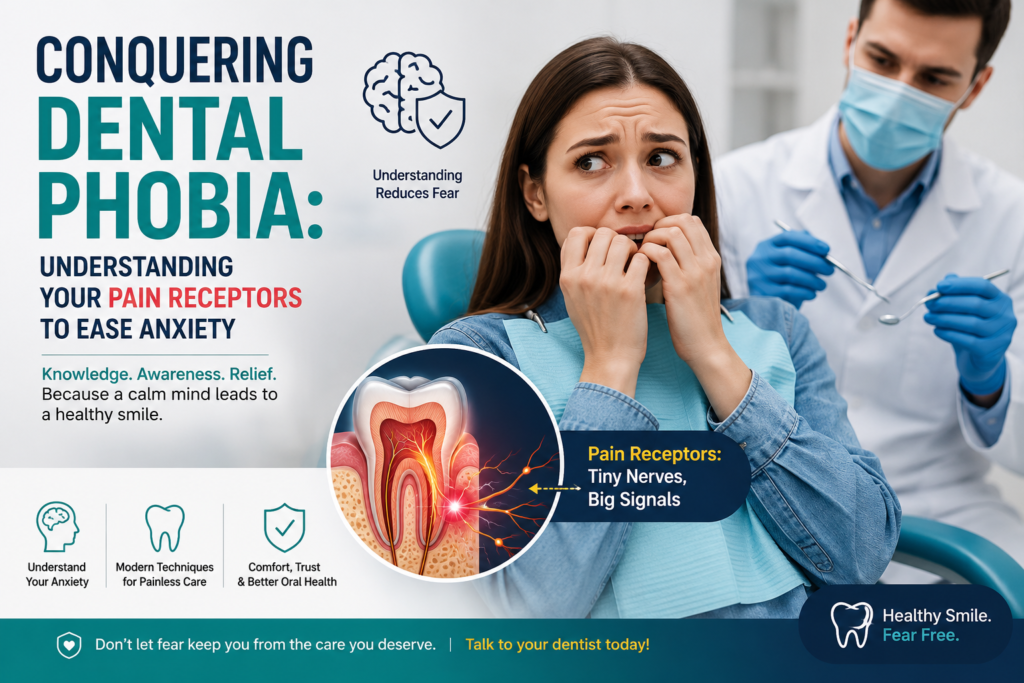
Introduction: Your Fear is Not “Just in Your Head”
For millions of people, sitting in a dental chair triggers a response that goes far beyond mild nervousness. It is a profound, paralyzing panic. In his candid video addressing dental avoidance, Dr. Kautilya Swaroop pointed out a stark reality: patients will willingly endure months of agonizing pain, struggling to eat or drink, simply to avoid the dentist.
When you ask someone with severe dental phobia why they are so afraid, the answers usually revolve around past trauma, the sound of the drill, or the dread of the injection. But society often dismisses this fear, telling patients to “just be brave” or that the anxiety is “all in their head.”
Scientifically speaking, this could not be further from the truth. Dental phobia is a deeply ingrained, physiological survival mechanism.
To truly conquer this fear, we must move away from judgment and look closely at the neurobiology of the human body. Relying on the foundational anatomical science from Orban’s Oral Histology and Embryology, this article breaks down exactly how your brain processes oral pain. By understanding the physical nature of your pain receptors, you will see exactly how modern dentistry hacks this biological system to guarantee a comfortable, stress-free experience.
The Biology of Panic: The Fight or Flight Response
When you walk into a dental clinic while suffering from dental phobia, your body does not know you are there to be healed. Because of past negative experiences or deeply held generational myths (like the infamous “door and string” extraction), your brain perceives the clinic as an active threat to your survival.
The moment you sit in the chair, your amygdala—the fear center of your brain—hijacks your nervous system. It floods your bloodstream with adrenaline and cortisol.
Instantly, your heart rate spikes, your breathing becomes shallow, your muscles tense, and your pain threshold plummets. This is the Fight or Flight response. In this heightened state of neurological alert, even the most gentle touch can be interpreted by the brain as sharp pain. You are biologically primed to feel agony. This is why Dr. Swaroop notes that anxious patients can sit in the chair for four hours, refusing to let the doctor even begin. Their nervous system is actively fighting for survival.
Meet Your Pain Receptors: The Nociceptors
To understand how we neutralize this fear, we must understand how the mouth feels pain.
According to Orban’s Histology, the oral cavity is not just skin and bone; it is one of the most densely innervated regions in the entire human body. Embedded throughout your gums (oral mucosa), your periodontal ligaments, and deep inside the pulp of your teeth are millions of highly specialized microscopic nerve endings called nociceptors.
Nociceptors are your body’s damage detectors. They are designed to react to extreme temperatures (hot or cold), mechanical pressure (crushing or tearing), and chemical damage (bacterial acids). When a tooth decays and bacteria invade the dentin, these nociceptors are triggered. They open their cellular channels, creating an electrical spark that travels to the brain to warn you of tissue damage.
The Trigeminal Superhighway
The reason oral pain feels so incredibly intense and overwhelming is because of the route it takes to your brain.
When a nociceptor in your tooth fires an electrical signal, it does not have a long way to travel. The mouth is wired directly into the Trigeminal Nerve (Cranial Nerve V), which is the largest and most complex of the cranial nerves. This nerve acts as a massive, high-speed biological superhighway.
Unlike a stubbed toe, where the pain signal has to travel up your entire leg and spinal cord, an oral pain signal shoots up the Trigeminal nerve and hits your brainstem in a fraction of a millisecond. It is immediate, loud, and impossible to ignore. This high-speed biological wiring is why a severe toothache can cause radiating pain through your entire jaw, ear, and head, making it the most dreaded pain a human can experience.
Hacking the Nervous System: The Modern Chemical Blockade
Because dental phobia is rooted in the fear of this high-speed pain network, modern dentistry does not rely on “bravery.” It relies on advanced chemistry.
The goal of painless dentistry is to physically intercept the electrical signals before they ever reach the Trigeminal superhighway. Here is exactly how the team at Shahi Dental Clinic hacks the biological system to eliminate your fear:
1. Surface Desensitization (The LA Spray) The most common trigger for the “Fight or Flight” panic is the anticipation of the needle. To bypass this, the dentist uses a Topical Anesthetic spray or gel. The molecules in this spray quickly sink into the topmost layer of your oral mucosa. They bind to the free nerve endings on the surface, temporarily paralyzing them. When the actual injection is administered, the surface nociceptors are physically incapable of firing a pain signal. The “pinch” is eliminated.
2. The Deep Sodium Channel Blockade Once the surface is numb, the precise local anesthetic is delivered near the nerve trunk. These modern anesthetics (like Lidocaine or Articaine) are molecular masterkeys. They soak into the nerve fibers and physically plug the microscopic “sodium channels” on the nerve membrane.
If the sodium channels are plugged, the nerve cannot generate an electrical charge. You can think of it like cutting the wire to a fire alarm. The dentist can clean out a deep cavity, remove an infected nerve, or extract a damaged tooth, and the nociceptors will try to fire, but the electrical signal is trapped. The brain registers absolutely nothing.
The Environment: Empathy as a Clinical Tool
While chemistry blocks the physical pain, it does not immediately stop the psychological panic. Adrenaline may still be coursing through the patient’s veins.
This is where the clinical environment and the practitioner’s approach become just as important as the medicine. Dr. Swaroop emphasizes a calm, transparent, and unhurried approach.
By taking the time to explain the instruments, demonstrating the surface spray, and giving the patient complete control over the pacing of the appointment, the dentist actively lowers the patient’s cortisol levels. When the brain realizes that the environment is safe and that the patient has the power to raise a hand and stop the procedure at any time, the amygdala stands down. The heart rate normalizes. The “Fight or Flight” response is deactivated.
Conclusion: Reclaiming Your Power
Dental phobia is a heavy burden to carry, and it is almost always born from a misunderstanding of what modern dentistry actually is.
Your fear is a valid, biological response to an outdated version of healthcare. But the science has evolved. We now understand the precise histology of your pain receptors and the neurobiology of your anxiety, and we have the exact chemical tools to manage both.
You do not need to rely on willpower to get through a dental appointment. You just need to trust the science and find a clinical team that prioritizes your peace of mind.
Stop fighting your nervous system and start healing. Book a calm, controlled, and completely painless consultation at Shahi Dental Clinic today.
📍 Shahi Dental Clinic Juran Chapra Main Road, Opposite Road No. 2, Muzaffarpur, Bihar
📞 Call/WhatsApp: +91-9525050250
🌐 Website: www.shahidentalclinic.com