
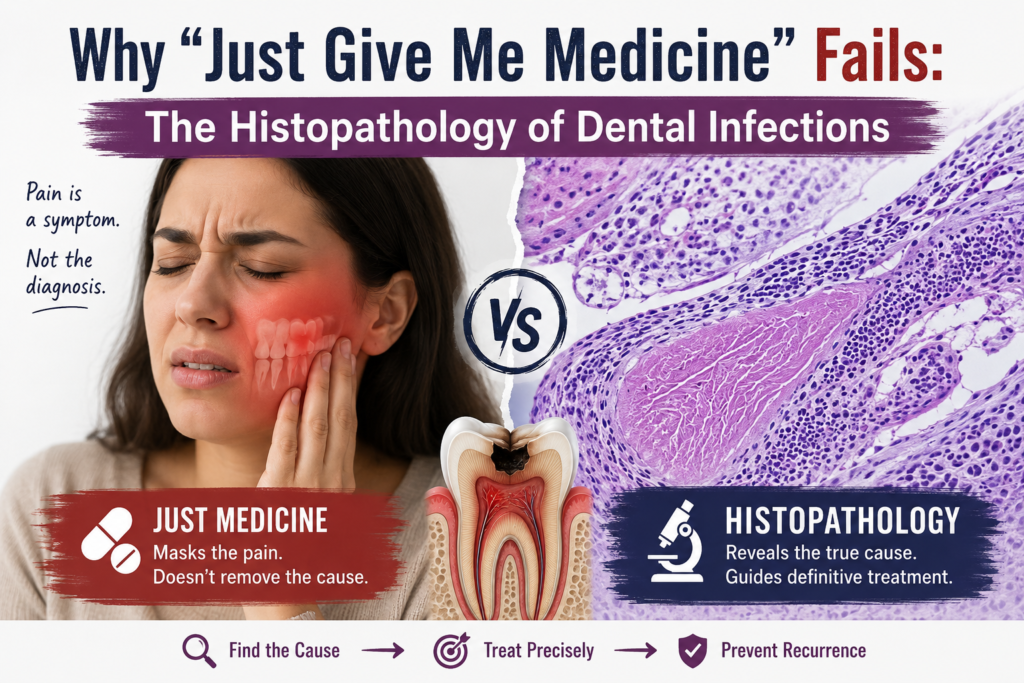
“Doctor sahab, bas thoda sa dawa de dijiyega… sui na, dant nahi nikaliyega!“ (Doctor, just give me a little medicine… no injections, don’t extract the tooth!)
If you have spent any time in a dental clinic, you have likely heard a patient make this exact plea. In his recent video addressing dental anxiety, Dr. Kautilya Swaroop highlights this incredibly common scenario at Shahi Dental Clinic. After nursing a severe toothache for six to seven months, a patient finally reaches their breaking point. Unable to eat, drink, or sleep, they arrive at the clinic—but their fear of the needle still overpowers their logic. They ask for a pill to make it all go away.
It is a deeply human response to fear. We are conditioned by general medicine to believe that if we have an infection, antibiotics will cure it, and if we have pain, analgesics will stop it.
However, a tooth is not like a sore throat or a scraped knee. From a biological and histological standpoint, attempting to cure an advanced dental infection with “just medicine” is not only ineffective—it is scientifically impossible. Relying on the foundational science of Orban’s Oral Histology and Embryology, this article explains the histopathology of a dying tooth and reveals exactly why mechanical intervention is the only true cure.
The Biological Fortress: Why Teeth Defy Medicine
To understand why oral medications fail to cure a toothache, we must look at how medicine travels through the human body.
When you swallow an antibiotic or a painkiller, it is digested, absorbed into your bloodstream, and pumped by your heart to the site of the infection. For the medicine to work, there must be a robust, active blood supply delivering the drug directly to the bacteria or the inflamed tissue.
According to Orban’s Oral Histology, the mature dental pulp (the living tissue inside your tooth) is housed in a rigid, unyielding chamber of dentin. Its only connection to the body’s main blood supply is through a microscopic opening at the very tip of the tooth root, known as the apical foramen.
When a deep cavity infects the pulp, the tissue becomes inflamed and swells. Because the surrounding dentin walls cannot expand, this swelling causes a rapid increase in internal pressure. This immense pressure effectively crushes the delicate blood vessels entering through the apical foramen, strangling the tooth’s own blood supply.
The Necrotic Safe Haven: Where Antibiotics Cannot Reach
Once the blood supply is cut off, the pulp tissue dies. In clinical terms, this is called pulpal necrosis.
This creates a terrifying biological loophole. You now have a hollow chamber inside your jawbone that is packed with millions of multiplying bacteria and rotting dead tissue. Because the blood vessels are destroyed, no blood can enter the inside of the tooth.
If no blood can enter the tooth, no antibiotics can enter the tooth. You can take the strongest antibiotics available on the market, and they will circulate through your jawbone, but they will never reach the bacteria hiding inside the dead tooth. The necrotic pulp chamber acts as an impenetrable fortress for the infection. The bacteria are completely safe from your immune system and your medication, free to multiply and produce toxic gases and pus.
Histopathology of the Spread: What Happens Beneath the Gums
If the bacteria cannot be killed by medicine, where do they go? They follow the path of least resistance. The multiplying bacteria, toxins, and pus eventually spill out through the bottom of the tooth root (the apical foramen) and invade the surrounding jawbone.
This triggers a massive immune response. Your body senses the bacterial invasion and sends white blood cells to fight it off, creating a battleground at the tip of the root. Histologically, this results in the formation of a periapical granuloma or a radicular cyst.
Your body essentially builds a wall of inflammatory tissue around the root tip to prevent the infection from spreading to your brain or bloodstream. However, this process comes at a high cost: as the granuloma grows, it secretes enzymes that eat away and dissolve your jawbone (bone resorption).
When a patient takes painkillers at this stage, they are merely masking the alarm bells. The pain might temporarily subside, but beneath the gums, the bacteria are actively destroying the bone structure.
The “Time Bomb” Effect: Chronic vs. Acute Infections
Patients who rely on “just medicine” often fall into a dangerous cycle. They take a course of antibiotics, the swelling temporarily reduces (because the antibiotics clear out the bacteria that spilled into the surrounding tissue with a blood supply), and the pain stops. They assume they are cured.
But the “motherlode” of bacteria remains safely hidden inside the dead tooth chamber. This is a chronic infection—a ticking time bomb.
The moment the patient’s immune system experiences a slight dip (due to stress, a cold, or fatigue), the bacteria swarm out of the tooth again. This time, it often results in an acute flare-up. The face swells dramatically, the lymph nodes enlarge, and the patient may develop a fever. If left untreated, this can progress to cellulitis or Ludwig’s Angina, severe conditions where the infection spreads to the tissue spaces of the neck, potentially blocking the airway and becoming life-threatening.
Why Mechanical Intervention is Non-Negotiable
Because medicine cannot reach the inside of the tooth, the only way to cure the disease is to physically remove the bacteria and the dead tissue. There are only two ways to achieve this in modern dentistry:
- Root Canal Treatment (RCT): The dentist opens the top of the tooth, uses microscopic instruments to physically scrub and clean out the dead, infected tissue from the root canals, disinfects the hollow chamber, and seals it shut. The fortress is cleaned and closed.
- Tooth Extraction: The entire tooth—along with the bacterial fortress inside it—is physically removed from the jawbone, allowing the surrounding tissues to heal.
“Dawa” (medicine) can only manage the symptoms; only mechanical intervention can cure the disease.
Overcoming the Fear: Treatment Does Not Mean Agony
The reason patients beg for medicine is that they associate the mechanical intervention (RCT or extraction) with agonizing pain. But as Dr. Swaroop continually emphasizes, this association is severely outdated.
Understanding the histopathology of the infection also helps us understand why treatment is now so comfortable. If a tooth is necrotic (dead), the nerve inside it is already dead. The pain you feel is from the pressure in the surrounding bone.
By using advanced Local Anesthesia (LA) sprays and precision injection techniques, the doctors at Shahi Dental Clinic can profoundly numb the surrounding bone and tissues without you feeling the needle. Once the area is numb, Dr. Swaroop can physically clean out the infection or remove the tooth while you feel absolutely nothing but light pressure.
Conclusion: Stop Masking the Problem
Popping a painkiller for a severely infected tooth is like turning off a fire alarm while your house is still burning. The noise stops, but the destruction continues.
Do not let fear force you into making poor biological choices. “Just medicine” will never cure a dead, infected tooth; it will only buy the bacteria more time to destroy your jawbone.
If you have been relying on painkillers to get through the week, it is time to face the root of the problem. Modern dentistry has removed the pain from the procedure, so you no longer have to choose between enduring a toothache or enduring a terrifying treatment.
Stop treating the symptoms and start curing the disease. Book a completely painless, stress-free consultation at Shahi Dental Clinic today.
📍 Shahi Dental Clinic Juran Chapra Main Road, Opposite Road No. 2, Muzaffarpur, Bihar
📞 Call/WhatsApp: +91-9525050250
🌐 Website: www.shahidentalclinic.com