
Introduction: The Psychology of Fear and the Anatomy of Relief
When analyzing patient acquisition data and consumer behavior in the healthcare sector, one glaring bottleneck consistently emerges: it is rarely the cost or the time that prevents patients from seeking care. It is pure, unadulterated fear. The fear of pain, specifically the fear of the dental injection, is the primary reason why manageable cavities are allowed to rot into severe oral infections.
In his recent video, Dr. Kautilya Swaroop addressed this psychological barrier head-on. He noted that patients will sit in the dental chair for hours, paralyzed by the thought of the needle, pleading, “Doctor sahab, sui mat dijiye!” (Doctor, please don’t give the injection!).
But what if the injection itself could be rendered completely painless?
In modern dental practice, the “thick, painful needle” of the past has been replaced by highly sophisticated, scientifically formulated anesthetics. To understand why you no longer need to fear the dentist, we must look at the microscopic battleground where pain is intercepted. Drawing on the principles of neuroanatomy and oral histology, this article decodes the science of painless dentistry and explains exactly how Local Anesthesia (LA) silences your oral nerves.
The Pathway of Pain: How Your Teeth Talk to Your Brain
To understand how anesthesia stops pain, we must first understand how pain travels.
The human face and mouth are wired by one of the most complex nerve structures in the body: the Trigeminal Nerve (Cranial Nerve V). This nerve branches out into thousands of microscopic fibers that supply sensation to your upper and lower jaws, the periodontal ligaments, the dental pulp, and the oral mucosa (the soft tissue of your gums).
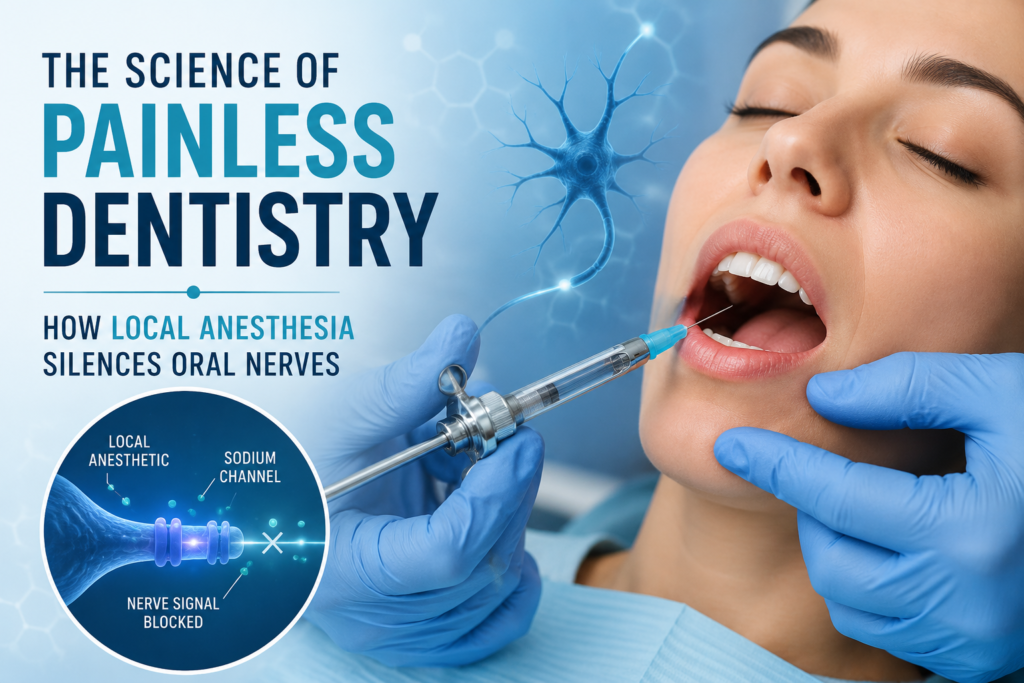
As outlined in histological texts like Orban’s, when a dentist touches a sensitive tooth or when an instrument presses against the gums, it triggers a response in the free nerve endings. This stimulation opens microscopic “gates” (sodium channels) on the nerve cell membrane. Positively charged sodium ions rush into the nerve cell, creating an electrical charge known as an action potential.
This electrical spark travels up the trigeminal nerve at lightning speed, reaching the brain in a fraction of a second. The brain translates this electrical signal into the sensation of pain. Therefore, pain is not an object; it is an electrical message. If you stop the message, you stop the pain.
Step 1: The Magic of Topical Anesthesia (The LA Spray)
The most common fear patients have is the initial prick of the needle piercing the gums. At Shahi Dental Clinic, this fear is neutralized before the injection even begins through the use of Topical Anesthetics (commonly known as LA sprays or gels).
The oral mucosa—the pink tissue lining your gums—is covered by an epithelium that protects the connective tissue underneath. Just below this surface lie the terminal nerve endings. When Dr. Swaroop applies a topical anesthetic spray to the specific site of treatment, the chemical agents quickly diffuse through the top layers of the epithelium.
The active ingredients in the spray bind to the sensory nerve endings on the very surface of the gums, temporarily paralyzing their ability to generate an action potential.
The Result: The surface tissue goes completely numb. When the actual injection is subsequently administered, the needle passes through this desensitized tissue. The patient feels pressure, but the sharp “pinch” that everyone dreads is entirely eliminated.
Step 2: The Deep Blockade: How Injectable Anesthesia Works
Once the surface is numb and the injection is painlessly delivered, the deeper Local Anesthetic takes over. This is where the true molecular science shines.
Modern local anesthetics (such as Lidocaine or Articaine) are molecularly designed to seek out and bind to the specific sodium channels on the nerve fibers located near the tooth root.
Imagine the nerve as a long highway, and the pain signal as a speeding car heading toward the brain. The sodium channels are the toll booths that allow the car to pass. The local anesthetic acts as a highly targeted roadblock. It locks onto the sodium channels from the inside, physically preventing them from opening.
Because the sodium ions cannot enter the nerve cell, no electrical charge (action potential) can be generated. The “pain message” simply cannot be created or transmitted.
The Result: The dentist can perform highly invasive procedures—drilling deep into the dentin, removing an infected pulp, or extracting a severely damaged tooth—and the brain registers absolutely nothing. The tooth is completely isolated from the body’s pain network.
Why You Feel “Fat” and Tingly
Patients often remark that their lips or cheeks feel enormous or swollen after receiving anesthesia, even when looking in the mirror reveals no physical swelling. This is a fascinating neurological illusion.
The local anesthetic blocks all sensory pathways in that specific quadrant of the mouth, including proprioception (the sense of where your body parts are in space). Because your brain is suddenly receiving zero sensory feedback from your lip or cheek, it becomes “confused” and interprets the lack of signals as the area being heavy, numb, or swollen. This tingling, swollen sensation is the ultimate proof that the sodium channel blockade is working perfectly.
Vasoconstrictors: Prolonging the Peace
To ensure that the patient remains comfortable throughout the entire procedure—whether it takes ten minutes or an hour—local anesthetics are often combined with a microscopic amount of a vasoconstrictor, such as epinephrine.
Blood vessels naturally want to flush foreign chemicals out of the tissue. If the anesthetic is flushed away too quickly by the bloodstream, the numbness will wear off before the procedure is finished. The vasoconstrictor temporarily narrows the blood vessels in the immediate area. This keeps the anesthetic concentrated right where the tooth is, prolonging the deep numbness and drastically reducing any minor bleeding during the procedure.
Conquering the Mind: The Role of the Dentist
While the biochemistry of local anesthesia is practically flawless, the final component of “painless dentistry” is human empathy.
As Dr. Swaroop emphasized, a patient might arrive at the clinic after months of agony, only to sit in the chair for hours, refusing the treatment out of sheer panic. Science can block the nerve, but only a skilled, patient practitioner can calm the mind. By transparently explaining the process—showing the patient the LA spray, explaining how it will numb the surface, and never rushing the procedure—the dentist lowers the patient’s heart rate and cortisol levels.
When the patient finally agrees to the process, they are almost universally surprised. The build-up of anxiety over months dissipates in seconds when they realize the procedure truly is painless.
Conclusion: Trust the Science, Relieve Your Pain
The fear of the dental chair is a relic of the past, born from an era before advanced molecular anesthetics and surface-numbing sprays. Today, enduring weeks of agonizing toothaches, difficulty swallowing, and sleepless nights because you are afraid of a needle is completely unnecessary.
We have mapped the nerves, we have isolated the pain receptors, and we have perfected the chemical blockade. Your treatment does not have to hurt.
Do not wait until a minor cavity turns into a life-altering infection. Trust the science of modern dentistry and the expertise of doctors who prioritize your comfort above all else.
Take the first step toward a pain-free smile. Book your stress-free consultation at Shahi Dental Clinic today.
📍 Shahi Dental Clinic Juran Chapra Main Road, Opposite Road No. 2, Muzaffarpur, Bihar
📞 Call/WhatsApp: +91-9525050250
🌐 Website: www.shahidentalclinic.com