
Introduction: The Generational Trauma of Tooth Pulling
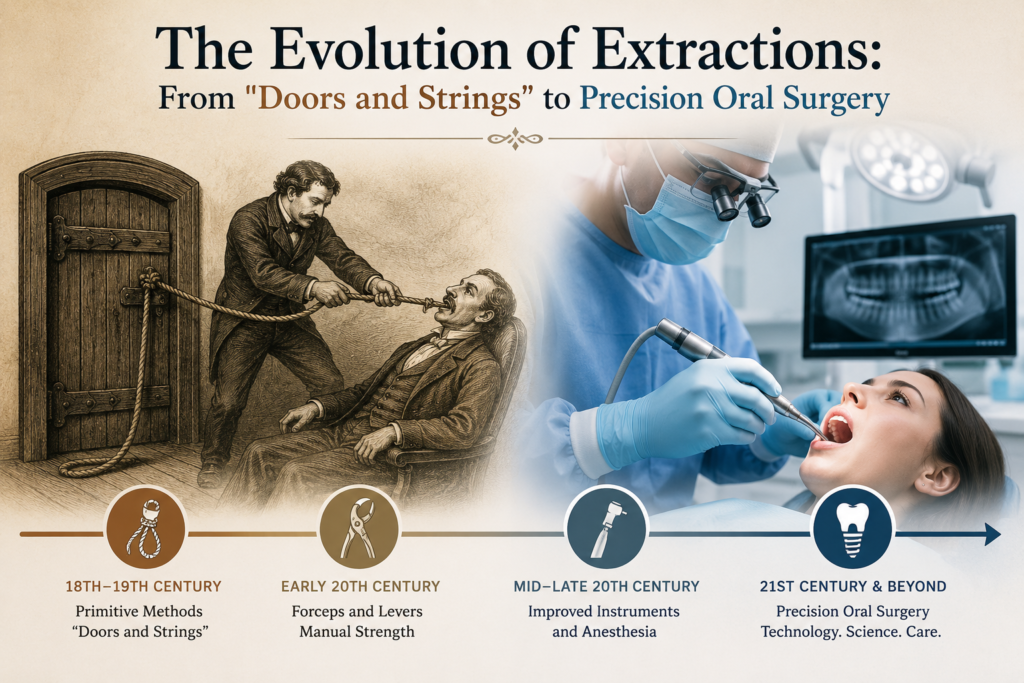
If you grew up in India, you have almost certainly heard the story. When a tooth needed to come out, the old-school, at-home remedy was simple, brutal, and terrifying: tie one end of a strong string around the offending tooth, tie the other end to a doorknob, and slam the door shut.
While this sounds like a cartoon gag today, the sheer violence of that image has embedded a deep, generational trauma into our collective psyche. It is exactly why patients walk into Shahi Dental Clinic trembling at the mere suggestion that a tooth might need to be removed. The word “extraction” conjures images of brute force, pulling, tearing, and immense pain.
However, as Dr. Kautilya Swaroop often explains to anxious patients, modern tooth removal has absolutely nothing to do with “pulling.”
To understand why a modern tooth extraction at a state-of-the-art clinic is a calm, painless, and highly controlled procedure, we must look at the microscopic architecture of the jaw. By exploring the cellular structures outlined in Orban’s Oral Histology and Embryology, we can see exactly why the “door and string” method was a biological nightmare—and how precision physics has replaced brute force.
The Biological Hammock: The Periodontal Ligament (PDL)
The greatest misconception about teeth is that they are solidly fused or glued to your jawbone. If this were true, chewing would send shockwaves directly into your skull, causing microscopic fractures every time you bit into an almond or a piece of hard candy.
Instead, nature designed a brilliant shock-absorption system. According to Orban’s Oral Histology, the root of your tooth sits inside a socket of bone (the alveolar bone), but the two never directly touch. They are separated by a tiny, specialized space filled with the Periodontal Ligament (PDL).
The PDL is not a single rubber band; it is a complex, microscopic hammock made of thousands of tough collagen fibers (known as Sharpey’s fibers). These fibers anchor into the cementum of the tooth root on one side and into the alveolar jawbone on the other. This suspends the tooth in a highly vascular, fluid-filled space, allowing it to move microscopically when you chew.
This ligament is densely packed with blood vessels and highly sensitive nerve endings. Understanding the PDL is the key to understanding why old extraction methods hurt, and why modern methods do not.
The “Brute Force” Era: A Histological Nightmare
When you envision the “door and string” method, or even the outdated techniques of early 20th-century dentistry, the approach was purely about upward, tearing force.
When a tooth is violently yanked upward, the thousands of collagen fibers in the PDL do not stretch gently; they tear simultaneously. Because the PDL is rich in sensory nerve endings, this abrupt tearing sends a massive, overwhelming shock of pain to the brain. Furthermore, pulling straight up creates a vacuum effect inside the bony socket, causing severe trauma to the surrounding alveolar bone and triggering a massive inflammatory response.
This brute-force trauma is what caused the excessive bleeding, facial swelling, and agonizing recovery times our grandparents talk about. It was biologically destructive.
The Modern Shift: Physics, Not Force
Today, a highly trained oral surgeon or dentist like Dr. Swaroop does not “pull” teeth. Instead, they perform a precise surgical maneuver utilizing biomechanics and physics to gently coax the tooth out of its socket.
The modern procedure relies on a technique called luxation. Rather than pulling upward, the dentist uses specialized, precision-engineered instruments (elevators and luxators) to apply slow, steady, and controlled pressure to the sides of the tooth.
Here is what happens on a microscopic level during a modern extraction:
- Severing the Fibers: The steady pressure slowly fatigues and stretches the collagen fibers of the PDL until they gently detach, rather than violently ripping them.
- Expanding the Socket: The alveolar bone surrounding the tooth is naturally slightly flexible. By applying controlled lateral pressure, the dentist microscopically expands the bony socket.
- The Release: Once the socket is expanded and the PDL fibers are fatigued, the tooth essentially becomes loose on its own. The dentist then simply lifts the tooth out of the space with forceps.
There is no yanking. There is no brute force. It is a calculated, gentle expansion and release.
The Magic of Profound Anesthesia: Why You Feel “Pushing,” Not Pain
Even with gentle luxation, severing the PDL would naturally cause pain—if the nerves were active. This is where the advanced anesthesia protocols discussed in our previous blogs come into play.
Before Dr. Swaroop begins any extraction at Shahi Dental Clinic, the area is treated with a topical LA spray, followed by a highly targeted local anesthetic. This anesthetic deeply blocks the nociceptors (pain receptors) in the Periodontal Ligament and the surrounding bone.
However, there is a fascinating neurological distinction you will notice in the chair. While the pain receptors are blocked, the proprioceptive nerve fibers (the ones that sense motion and heavy pressure) are thicker and sometimes still transmit dull signals.
This is why, during a modern extraction, you will feel the dentist pushing firmly against your jaw, but you will feel absolutely zero sharpness or pain. Dr. Swaroop will always prepare you for this, explaining, “You will feel me pressing on your jaw, just like a heavy massage, but there will be no pain.” Knowing the difference between pressure and pain completely eliminates the panic.
The Aftermath: Clean Sockets and Faster Healing
The benefits of precision oral surgery extend far beyond the moment the tooth is removed.
Because modern extractions do not traumatize the surrounding alveolar bone or tear the gums violently, the histological healing process begins instantly and optimally. The clean, un-fractured socket fills with a healthy blood clot within minutes. This clot is the biological scaffolding required for the body to send in fibroblasts and osteoblasts—the cells that will eventually lay down new gum tissue and regenerate the bone.
When a tooth is removed gently, patients experience minimal postoperative swelling, practically zero bleeding once they leave the clinic, and a remarkably fast, painless recovery period.
Conclusion: Leave the Nightmares in the Past
The terror of tooth extraction is a ghost from the past, built on the trauma of outdated, unscientific methods. The days of tying strings to doors, or facing aggressive, painful pulling in a dental chair, are over.
Today, tooth removal is a highly refined surgical procedure that respects the microscopic anatomy of your mouth. Through the careful management of the Periodontal Ligament, the application of physics over force, and the use of profound local anesthesia, losing a severely damaged tooth is now a calm, stress-free experience.
Do not let generational myths dictate your healthcare decisions. If you have a severely decayed or broken tooth that needs to be removed, there is nothing to fear.
Experience the comfort and precision of modern oral surgery. Book your painless extraction consultation at Shahi Dental Clinic today.
📍 Shahi Dental Clinic Juran Chapra Main Road, Opposite Road No. 2, Muzaffarpur, Bihar
📞 Call/WhatsApp: +91-9525050250
🌐 Website: www.shahidentalclinic.com